Zoran J Pavlovic 1 2, Gabrielle E Smotrich 3, Erika P New 1 2, Samad Jahandideh 4, Kate Devine 4, Anthony N Imudia 1 2, Shayne Plosker 1 2
Affiliations Expand
- PMID: 39781068
- PMCID: PMC11705573
- DOI: 10.1016/j.xfre.2024.09.003
Abstract
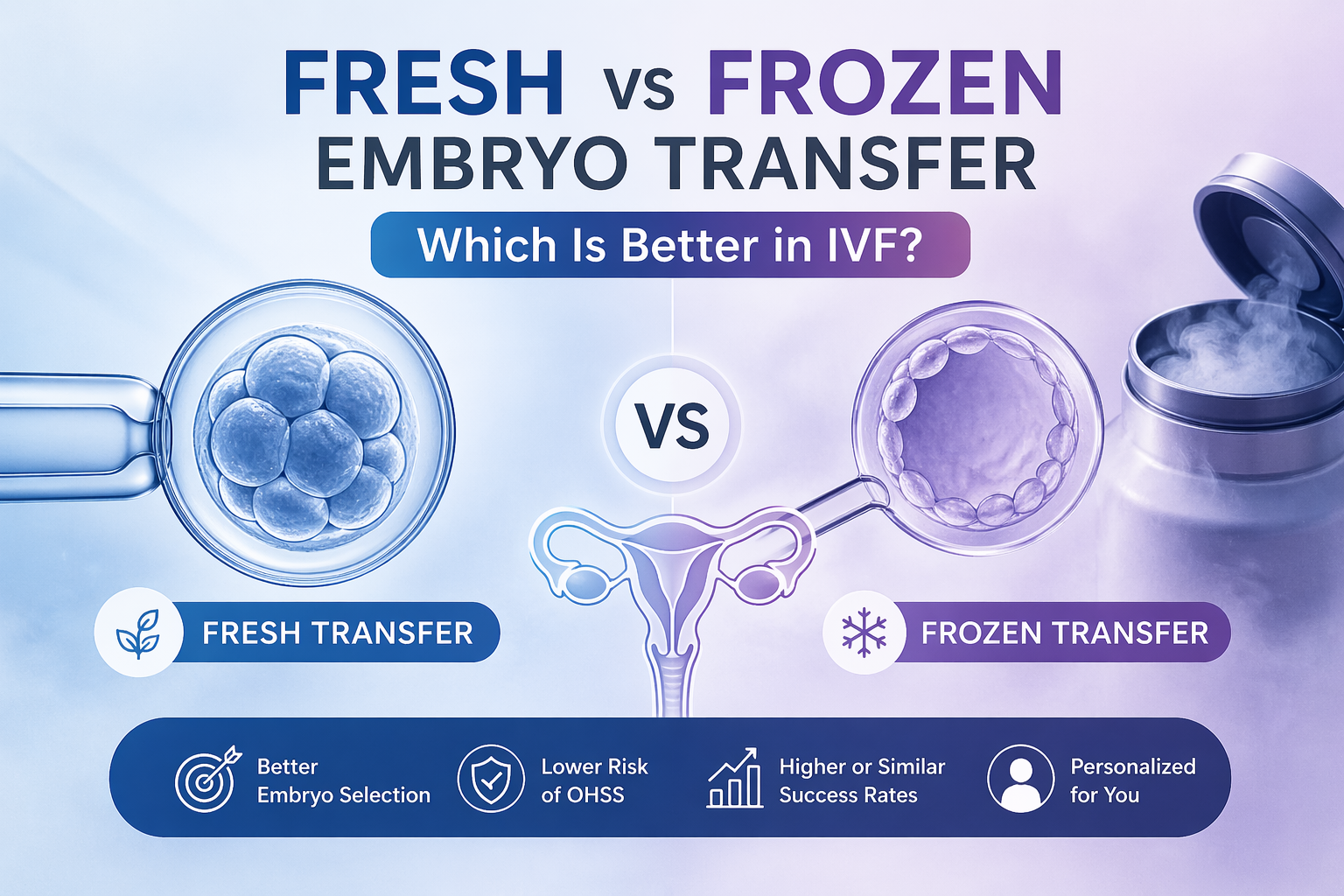
Objective: To compare pregnancy outcomes after single blastocyst embryo transfer among patients whose first autologous embryo transfer was either a fresh embryo transfer or a frozen embryo transfer (FET) after a freeze-all, in the absence of preimplantation genetic testing for aneuploidy (PGT-A).
Design: A multicenter retrospective cohort analysis.
Setting: National multicenter fertility practice.
Patients: A total of 8,319 autologous first blastocyst embryo transfers in the absence of PGT-A were analyzed. Of them, 6,755 transfers were fresh embryo transfer (ET) and 1,564 transfers were FET after freeze-all.
Exposure: Patients underwent either a fresh or a frozen initial autologous, single blastocyst transfer in the absence of PGT-A.
Main outcome measures: Primary outcome measure was live birth rate. Secondary outcome measures included positive pregnancy test, clinical pregnancy rate, and miscarriage rate.
Results: Live birth rate was comparable between the fresh ET and FET groups in the absence of PGT-A, after performing generalized estimating equation modeling to account for age, body mass index, antral follicle count, basal follicle-stimulating hormone, progesterone on day of trigger/day of final lining check, peak estradiol during in vitro fertilization stimulation cycle, number of oocytes retrieved during ovarian stimulation cycle, and primary diagnosis. Similarly, the secondary outcome variables of positive pregnancy test, clinical pregnancy rate, and miscarriage rates were comparable between the cohorts. These findings were observed in the entire study group, within each age category of <35, 35-37, 38-40, and >40 and among each stratified peak estradiol group.
Conclusions: In the absence of PGT-A, patients and fertility providers can elect to pursue either fresh ET or embryo freeze-all with subsequent FET during the first autologous in vitro fertilization cycle.
Keywords: In vitro fertilization; assisted reproductive technology; fresh embryo transfer; frozen embryo transfer; non-PGT-A cycles.
© 2024 The Authors.
Conflict of interest statement
Z.J.P. has nothing to disclose. G.E.S. has nothing to disclose. E.P.N. has nothing to disclose. S.J. has nothing to disclose. K.D. has nothing to disclose. A.N.I. has nothing to disclose. S.P. has nothing to disclose.
Figures


Similar articles
- International Committee for Monitoring Assisted Reproductive Technologies (ICMART): world report for cycles conducted in 2017-2018.Baker VL, Dyer S, Chambers GM, Keller E, Banker M, de Mouzon J, Elgindy E, Bai FM, Ishihara O, Jwa SC, Kupka MS, Zegers-Hochschild F, Adamson GD.Hum Reprod. 2025 Jun 1;40(6):1110-1126. doi: 10.1093/humrep/deaf049.PMID: 40239109
- Assessing the impact of both preimplantation genetic testing for aneuploidy with blastocyst morphologic grade on live birth rates in frozen embryo transfers from fresh and frozen donor oocytes.Dennis A, Jain N, Clarke EA, Blakemore JK.Arch Gynecol Obstet. 2025 Mar;311(3):819-826. doi: 10.1007/s00404-024-07876-6. Epub 2025 Feb 13.PMID: 39945788Free PMC article.
- Age-related increase in live-birth rates of first frozen thaw embryo versus first fresh transfer in initial assisted reproductive technology cycles without PGT.Wang SF, Seifer DB.Reprod Biol Endocrinol. 2024 Apr 13;22(1):42. doi: 10.1186/s12958-024-01210-0.PMID: 38615016Free PMC article.
- Higher probability of live-birth in high, but not normal, responders after first frozen-embryo transfer in a freeze-only cycle strategy compared to fresh-embryo transfer: a meta-analysis.Bosdou JK, Venetis CA, Tarlatzis BC, Grimbizis GF, Kolibianakis EM.Hum Reprod. 2019 Mar 1;34(3):491-505. doi: 10.1093/humrep/dey388.PMID: 30689865
- Preimplantation genetic testing for aneuploidies (abnormal number of chromosomes) in in vitro fertilisation.Cornelisse S, Zagers M, Kostova E, Fleischer K, van Wely M, Mastenbroek S.Cochrane Database Syst Rev. 2020 Sep 8;9(9):CD005291. doi: 10.1002/14651858.CD005291.pub3.PMID: 32898291Free PMC article.
Cited by
- Preimplantation Genetic Testing for Aneuploidy Versus Morphological Selection in Women Aged 35-42: Results of a Pilot Randomized Controlled Trial.Beebeejaun Y, Bakalova D, Mania A, Copeland T, Sarris I, Nicolaides K, Capalbo A, Sunkara SK.J Clin Med. 2025 Jul 21;14(14):5166. doi: 10.3390/jcm14145166.PMID: 40725861Free PMC article.
- Optimal timing for triggering oocyte maturation during in vitro fertilization cycles varies between gonadotropin-releasing hormone agonist and human chorionic gonadotropin use.Enatsu N, Furuhashi K, Otsuki J, Enatsu K, Okamoto E, Kokeguchi S, Shiotani M.F S Rep. 2025 Jul 29;6(4):446-454. doi: 10.1016/j.xfre.2025.07.009. eCollection 2025 Dec.PMID: 41473569Free PMC article.
References
Fatemi H.M., Popovic-Todorovic B., Humaidan P., Kol S., Banker M., Devroey P., et al. Severe ovarian hyperstimulation syndrome after gonadotropin-releasing hormone (GnRH) agonist trigger and “freeze-all” approach in GnRH antagonist protocol. Fertil Steril. 2014;101:1008–1011. – PubMed
- AbdelHafez F.F., Desai N., Abou-Setta A.M., Falcone T., Goldfarb J. Slow freezing, vitrification and ultra-rapid freezing of human embryos: a systematic review and meta-analysis. Reprod Biomed Online. 2010;20:209–222. – PubMed
- Roque M., Haahr T., Geber S., Esteves S.C., Humaidan P. Fresh versus elective frozen embryo transfer in IVF/ICSI cycles: a systematic review and meta-analysis of reproductive outcomes. Hum Reprod Update. 2019;25:2–14. – PubMed
- Mizrachi Y., Horowitz E., Farhi J., Raziel A., Weissman A. Ovarian stimulation for freeze-all IVF cycles: a systematic review. Hum Reprod Update. 2020;26:118–135. – PubMed
- Bodri D., Guillén J.J., Trullenque M., Schwenn K., Esteve C., Coll O. Early ovarian hyperstimulation syndrome is completely prevented by gonadotropin releasing-hormone agonist triggering in high-risk oocyte donor cycles: a prospective, luteal-phase follow-up study. Fertil Steril. 2010;93:2418–2420. – PubMed